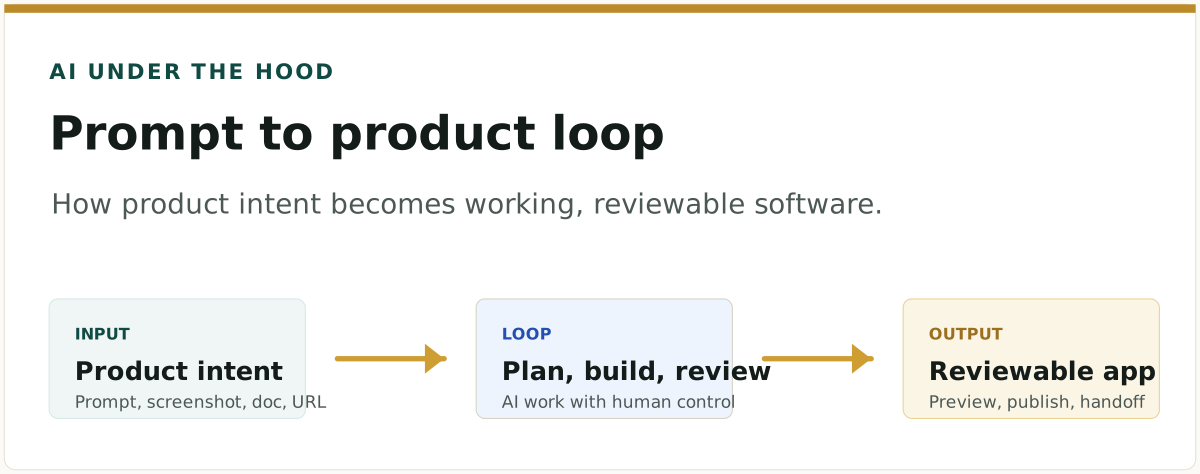
Lovable's obvious promise is simple: describe an app, get something working.
The more useful product move is what happens around that promise. Lovable pulls product intent, planning, UI generation, backend setup, preview, iteration, deployment, and code handoff into one workflow.
That matters because the output is not just a pretty mockup. It can become a working, reviewable app that a founder can show, a PM can test, an operator can use, or an engineering team can harden.
Quick Read
What To Look At
Product Surface
Prompt, screenshot, doc, URL, or project context can become a working app.
User Workflow
A slow handoff chain becomes a plan-build-review loop.
AI System
Planning, context, generation, tools, preview, scans, and handoff work together.
Product Decision
Plan mode separates thinking from doing, which makes AI autonomy easier to trust.
Business Impact
Teams learn faster before committing expensive engineering resources.
Risk
Speed creates review pressure once generated apps touch real users and data.
Subscribe Free To Continue
Unlock the full Lovable teardown here.
Enter your email once and keep reading on this page. The full teardown is free, and you will also get AI Under the Hood in your inbox.
No payment. No paid tier. Just the free teardown and future AI product breakdowns.
1. Product Surface
What Lovable Actually Changes
Lovable is useful because it moves the user from idea to artifact. The user can start with natural language, a screenshot, a document, a spreadsheet, a URL, or existing project context, then iterate toward a functioning web app.
Before
- Write a PRD or rough spec.
- Create static mockups.
- Wait for engineering or agency capacity.
- Review late, after the work has already moved downstream.
With Lovable
- Describe the app or upload context.
- Use Plan mode to inspect the approach.
- Use Build mode to generate or edit the app.
- Review preview, comments, diffs, scans, and publish paths.
2. Workflow Shift
Where The Handoff Chain Collapses
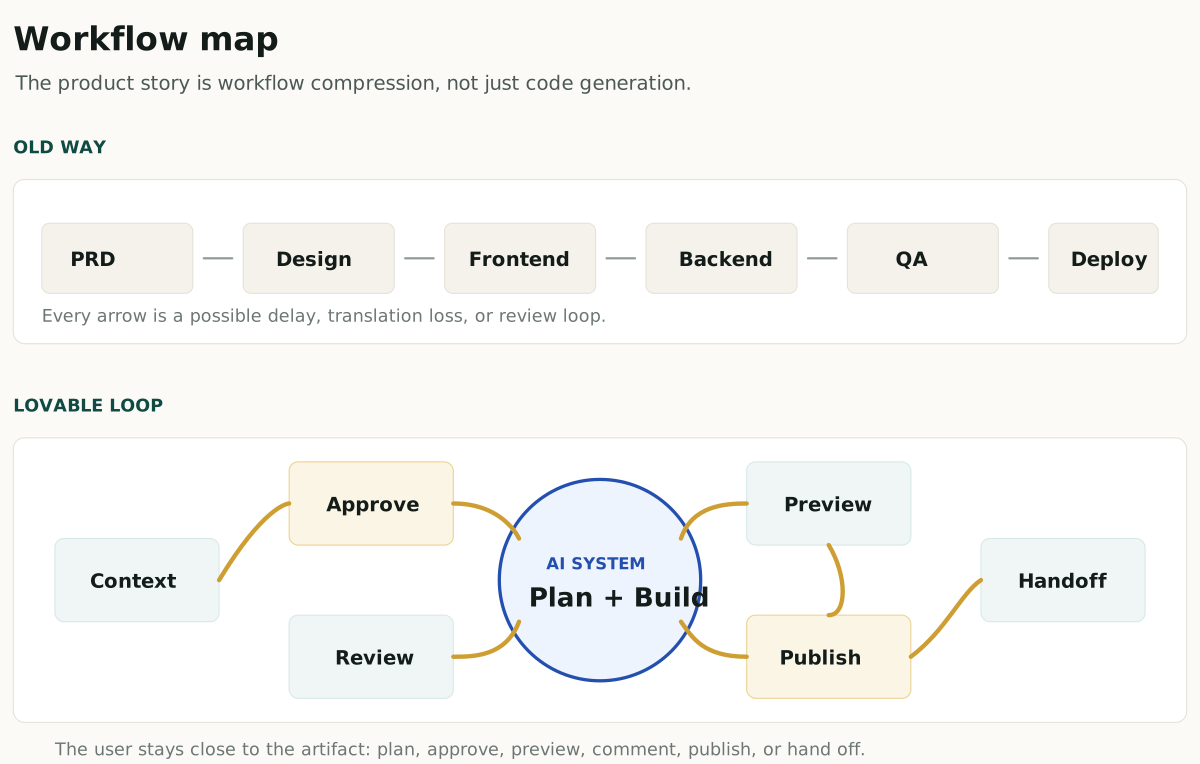
The important shift is not that every step disappears. The shift is that more of the work happens inside one reviewable loop.
The user can see the app, comment on the app, ask for changes, inspect the direction, and publish or hand off the result. That turns product review into product input.
Old shape: idea -> PRD -> design -> engineering -> QA -> deploy -> review.
Lovable shape: prompt/context -> plan -> build -> preview -> feedback -> publish or GitHub handoff.
3. System View
The Mental Model
Some parts of Lovable are visible from the outside. Other parts, like exact model routing and internal orchestration, are not public. The useful view is a practical product map: what the user gives the system, what the system appears to do, and where the user gets control back.
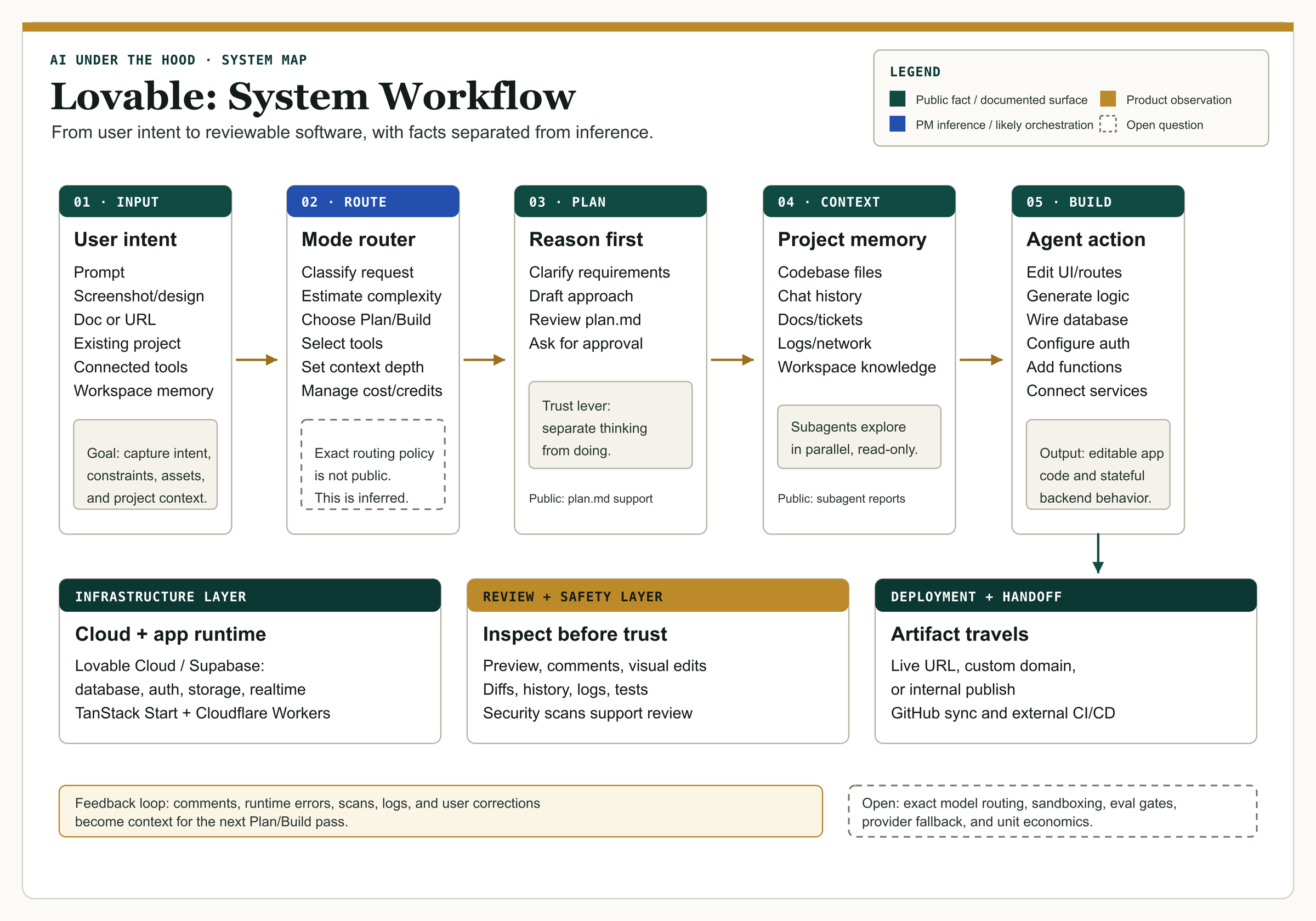
General system workflow: user intent enters the loop, the agent plans and builds, review surfaces create feedback, and the artifact can move to publish or GitHub handoff.
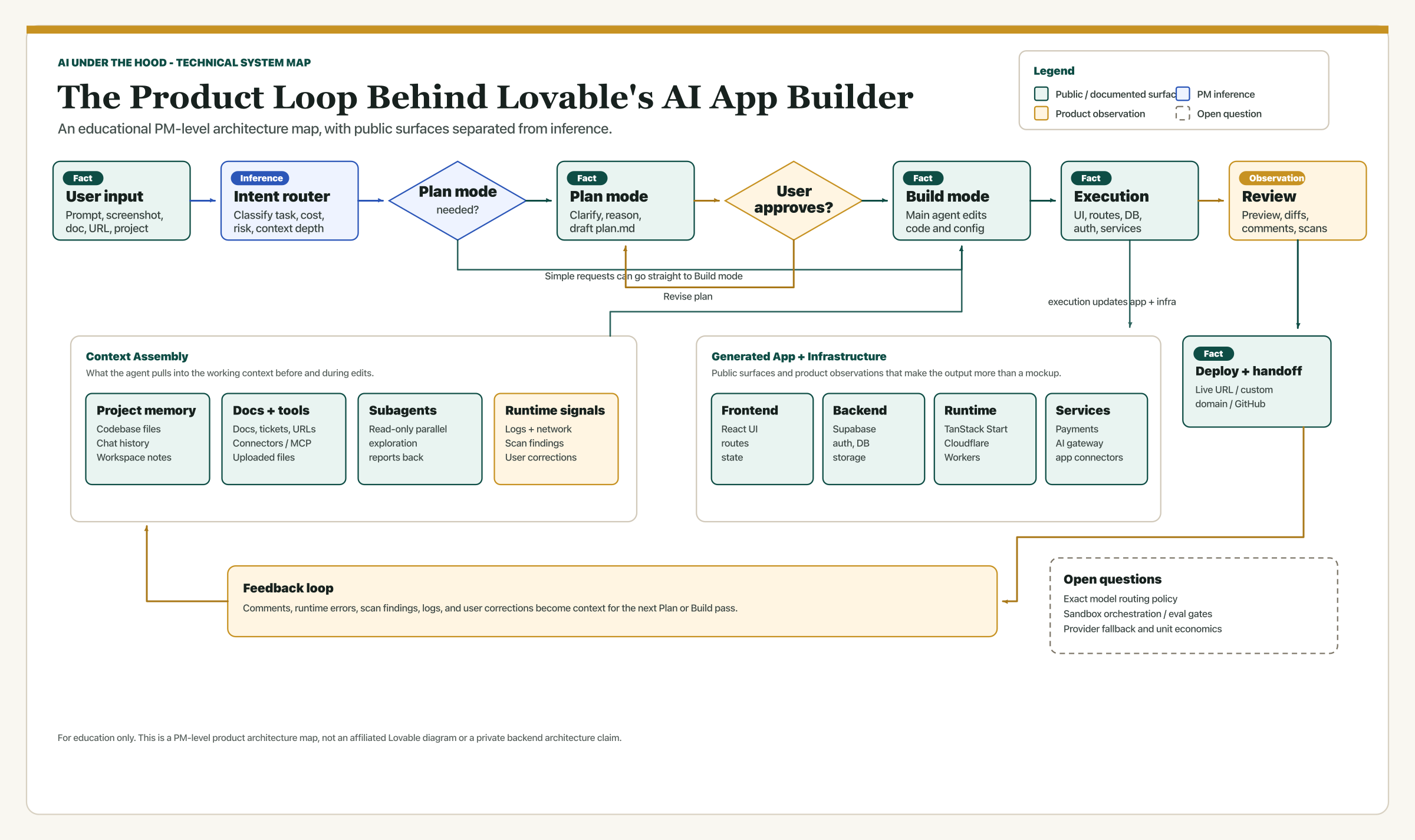
A deeper architecture view for technical readers: routing, planning, context assembly, build execution, generated app infrastructure, review, deployment, feedback, and open questions.
| Layer | What It Does | Why It Matters |
|---|---|---|
| Input | Reads prompts, files, screenshots, URLs, and project context. | The system needs the user's intent and constraints. |
| Plan | Clarifies, reasons, and proposes an approach before code changes. | The user can inspect direction before action. |
| Build | Generates or edits UI, routes, logic, backend wiring, and config. | The idea becomes working software. |
| Review | Shows preview, diffs, comments, logs, scans, and history. | The user can catch issues and steer iteration. |
| Handoff | Publishes, connects domains, or syncs to GitHub. | The artifact can travel beyond the prompt session. |
4. Trust Architecture
The Product Decision That Makes It Work
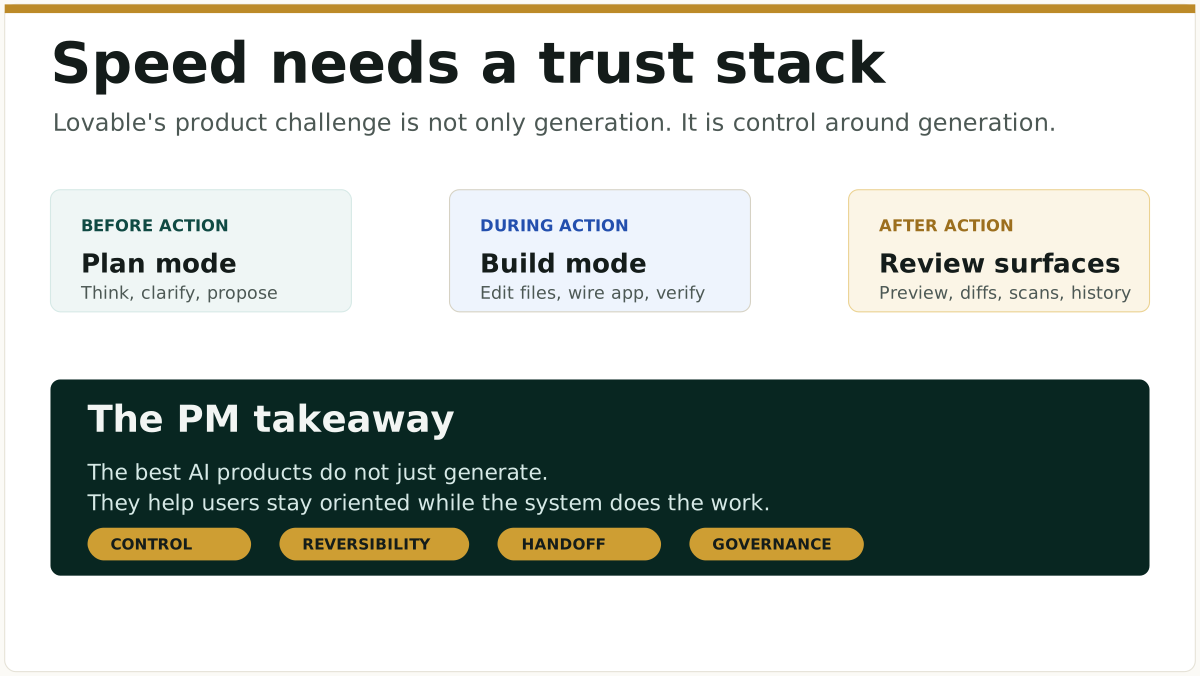
The strongest Lovable product decision is the split between Plan mode and Build mode.
Plan mode lets the AI think before touching the app. Build mode lets the AI act after the user has a reviewable direction. That middle state matters because it gives the user a chance to approve, redirect, or ask questions before execution.
The same trust pattern appears in the surrounding surfaces: live preview, visual edits, comments, diffs, history, scans, and GitHub sync. The product lesson is simple: AI products become easier to trust when they separate thinking, doing, reviewing, and handing off.
5. Business Impact
Why Teams Care
Lovable changes the economics of product discovery. The value is not "AI replaces engineering." The better framing is that teams can learn faster before committing expensive resources.
| User | Before | With Lovable | Metric That Moves |
|---|---|---|---|
| Founders | Hire, wait, or fake it in slides. | Test a working MVP shape sooner. | Validation speed, cost avoided. |
| PMs and designers | Use static mocks for alignment. | Show realistic workflows with state and interaction. | Discovery speed, stakeholder clarity. |
| Operators | Wait for internal-tool backlog space. | Turn process descriptions into workflow tools. | Productivity, backlog reduction. |
| Agencies and developers | Spend time on repetitive scaffolding. | Start from a generated first pass. | Delivery throughput. |
6. Risk
Speed Still Needs Governance
The same thing that makes Lovable powerful also creates risk: software creation starts to feel easy.
That is excellent for exploration. It is dangerous if every generated app is treated as production-ready by default. The first version of an MVP can move quickly, but production still needs engineering judgment, security review, testing, performance work, privacy review, and maintainability decisions.
- Reliability: AI can fix one bug while introducing another.
- Security: nontechnical users may miss weak auth, permissions, or data handling.
- Maintainability: generated code can become hard to reason about as the app grows.
- Workflow ownership: code export helps, but cloud, connectors, conventions, and deployment paths still shape dependency.
- Compliance: serious production apps need clear ownership, review, and governance.
Final Take
Generation As A Managed Workflow
Lovable is interesting because it shows where AI product design is going: not generation as a standalone feature, but generation as a managed workflow.
The user is no longer only writing a spec, waiting for a team, or staring at a blank codebase. The user is steering a system that can plan, build, preview, revise, publish, and hand off work.
The future PM skill is not only writing better requirements. It is knowing how to frame work for AI systems, review AI-generated output, design trust loops, and decide when a fast prototype is enough versus when human judgment must take over.
Try This Lens
Five Questions For Any AI Product
- What workflow did it compress?
- What does the user review before trusting the output?
- Where does the product separate thinking from doing?
- What business metric moves because of the new workflow?
- What governance layer is needed before serious adoption?
Sources And Further Reading
- Lovable docs: product introduction
- Lovable docs: Plan mode
- Lovable docs: Agent / Build mode
- Lovable blog: subagents in Lovable
- Lovable blog: building apps using TanStack Start
- Lovable blog: app protection and security scans
- Lovable blog: build economy report
For educational purposes only. This article is not affiliated with Lovable and does not claim access to Lovable's private backend architecture.